Music Man Engine
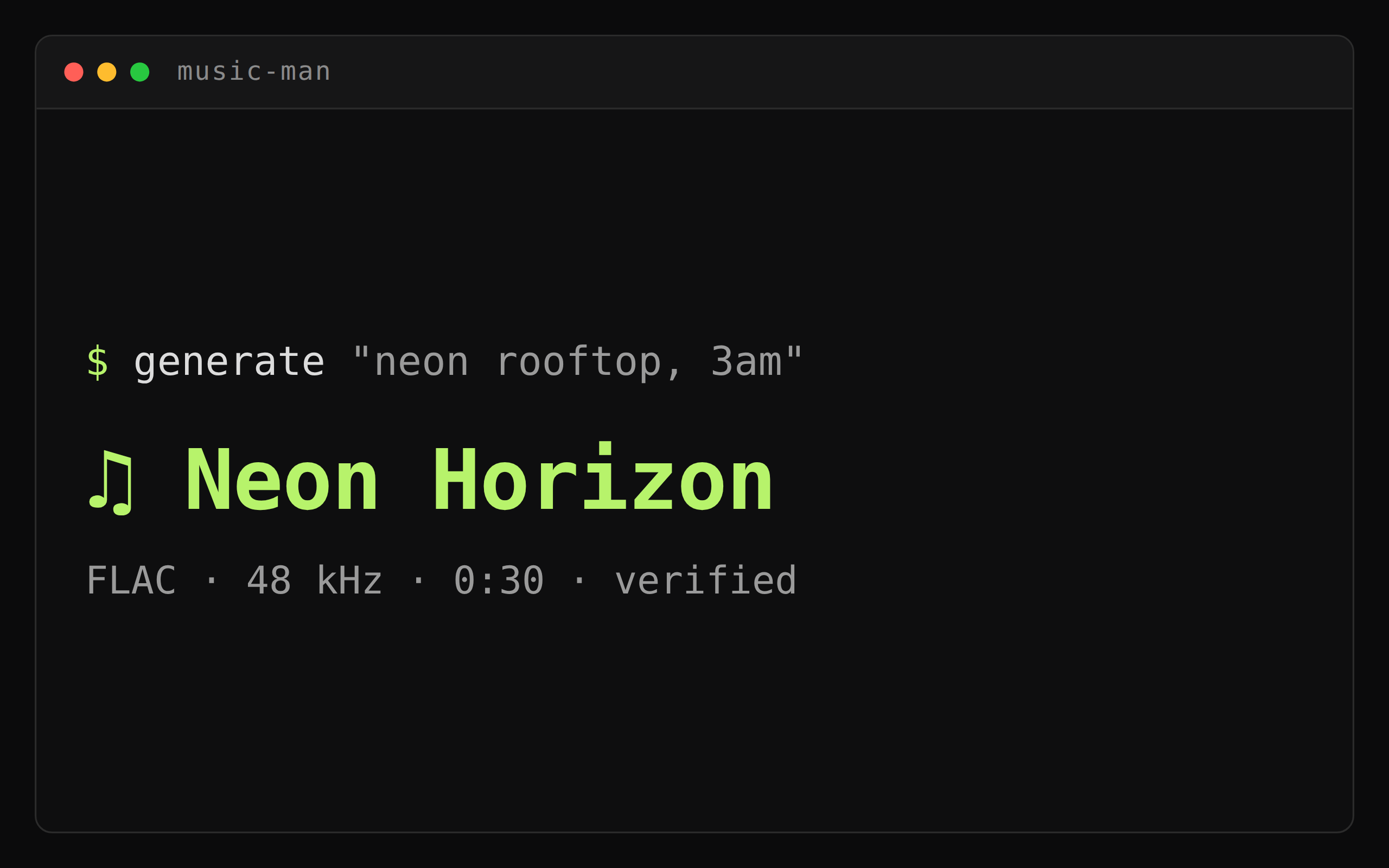
Headless song generation you run yourself. A rough idea goes in, a local LLM writes the song, and your own music model renders the audio.
One file, no installation, no dependencies beyond Python. It is the engine underneath Music Man Studio, offered on its own for people who would rather work in a terminal or wire it into something else.
Download Music Man Engine
v0.3.0 · 139 KB · zipsha256 · verify with sha256sum -c SHA256SUMS
What you need
The engine generates nothing by itself — it drives software you run. Those services can live on this machine or another one on your network.
Python 3.10 or newer
Check with python3 --version. Nothing else to install.
Ollama, with a model pulled
Writes the lyrics, structure and style brief.
ComfyUI with a music model
ACE-Step or MiniMax-Music3 renders the audio.
ffmpeg (optional)
Only for the MP3 playback copy alongside the FLAC.
Quick start
Unzip the bundle, point it at your services, and write a song. The -I flag runs Python in isolated mode so the bundle ignores anything unusual in your environment.
export MUSICMAN_OLLAMA_URL=http://localhost:11434
export MUSICMAN_OLLAMA_MODEL=qwen3.8:latest
export MUSICMAN_COMFYUI_URL=http://localhost:8188
export MUSICMAN_OUTPUT_DIR="$PWD/music-man-output"

python3 -I music_man-0.3.0.pyz version
python3 -I music_man-0.3.0.pyz generate "a late-night drive through neon city rain, synthwave"
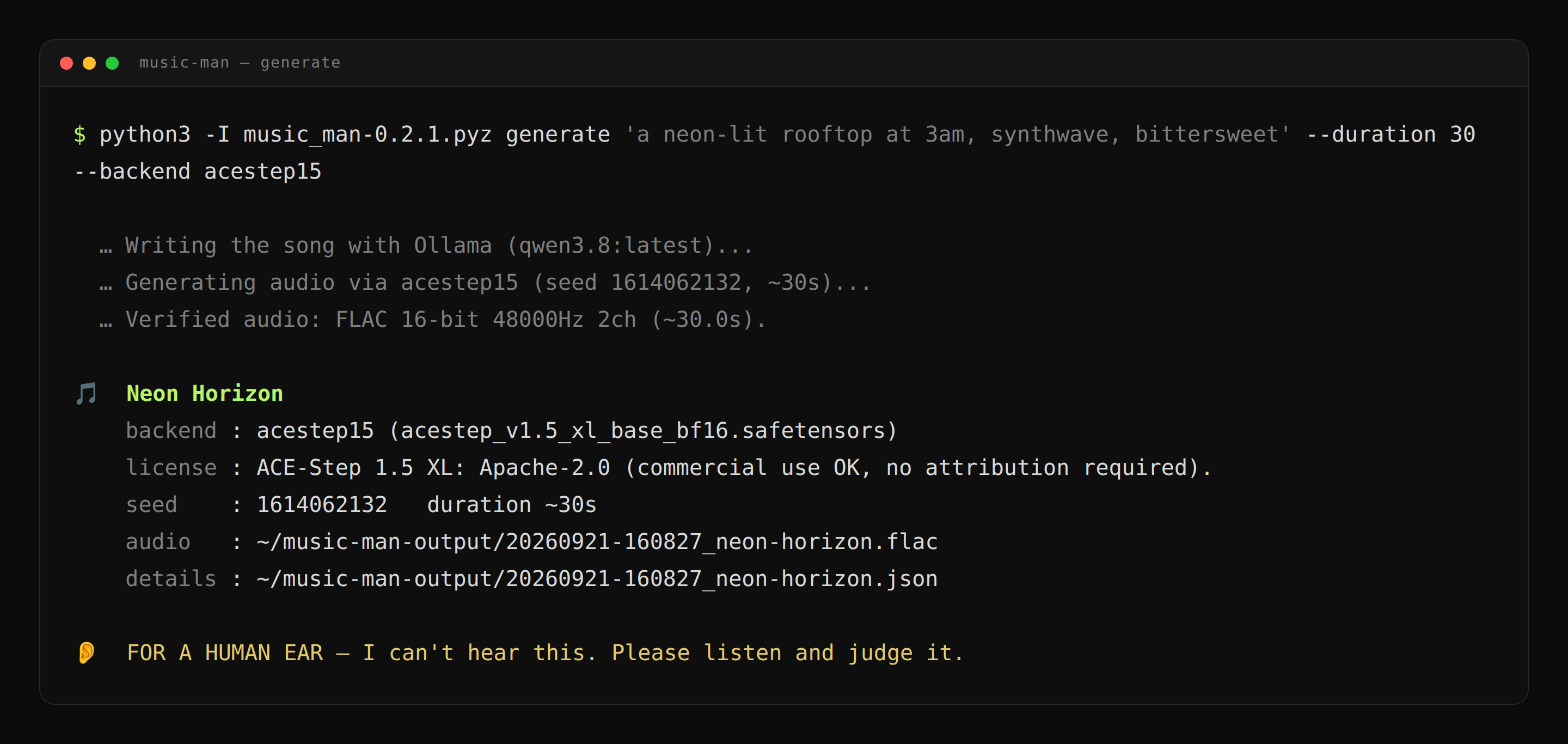
Songs land in your output folder as <timestamp>_<slug>.flac with a JSON sidecar recording the idea, style, seed, model and settings, so any render can be traced or repeated.
Commands
| generate "IDEA" | idea → song → audio, in one shot |
| recipe draft|validate|generate|normalize | draft an editable song JSON, tweak it, then render |
| band create|from-song|derive|list|show|delete | reusable sound signatures so songs share an identity |
| master SOURCE | loudness-normalize, EQ and gain an existing file |
| version | print the version as JSON |
Add --help to any command for its options.
What it does
One file, nothing to install
A single .pyz that runs on Python 3.10+. No pip, no virtualenv, no dependencies — the standard library is the whole requirement.
Idea in, finished song out
A local LLM writes the lyrics, structure and style brief. A music model renders the audio. You get a FLAC and a sidecar recording exactly how it was made.
Editable recipes and bands
Every song is a JSON recipe you can edit between writing and rendering. Freeze a sound you like as a “band” and stamp it on later songs.
Mastering on your own box
Loudness-normalize, three-band EQ and gain an existing file, and optionally write an MP3 alongside the master.
Your machines, your files
No account, no telemetry, no cloud. It talks only to the Ollama and ComfyUI URLs you configure, and writes only where you point it.
Scriptable and embeddable
A plain CLI for humans and a newline-delimited JSON protocol for apps — the same surface Music Man Studio is built on.
Music Man Studio
A desktop app built on this engine, for people who would rather not live in a terminal: write and edit songs section by section, keep a library of bands and recipes, watch renders progress, and master without memorizing flags. It runs the same engine you can download here, against your own models.
In development. The engine below is the part that's ready today.
License and models
Freeware, not open source
Free to download and use on as many machines as you like, including commercially. No redistribution, resale or repackaging. The bundle's source is readable, which is not a grant of rights — all rights reserved.
Read the full license →The models have their own terms
ACE-Step is Apache-2.0. MiniMax-Music3 uses a community license that requires crediting the model and disclosing AI generation, with a revenue limit on commercial use. Check whatever you run before publishing or monetizing what you make.
Your music is yours
The license claims no ownership of anything you generate. What you can do with it depends on the models you used, not on this download.
No warranty, no support
This is provided as-is. The engine reports only objective facts about what it produced — format, duration, validity, level — and never claims a song sounds good. That judgment is yours.